The Challenge
What we set out to solve
- 1Fragmented Records: Each agency operates independently, maintaining its own formats and systems. At the national level, this resulted in duplicated efforts and irreconcilable data.
- 2Manual Processes: Paper-based and inconsistent data capture led to incomplete and inaccurate records, undermining analysis.
- 3Delayed Reporting: Information moved periodically rather than continuously, creating a lag between real-world events and institutional awareness.
- 4Agency Silos: Without a shared platform, coordination across institutions broke down, affecting everything from case management to detainee tracking.
- 5No Real-Time Insight: Policy makers lacked a live, unified view of justice system activities, forcing reactive rather than proactive decision-making.
The Solution
How we delivered
- 1Standardized Data Capture: Replacing inconsistent, manual formats with structured inputs across all connected agencies.
- 2Unified Dashboard: Providing the Ministry of Justice with a consolidated, real-time view of criminal and detention data.
- 3Agency-Level Onboarding: Training users not just on system functionality, but on how it fits into their operational routines.
- 4Hands-On Implementation: Supporting adoption through real-world usage, ensuring the system becomes embedded, not just installed.
The Results
What changed
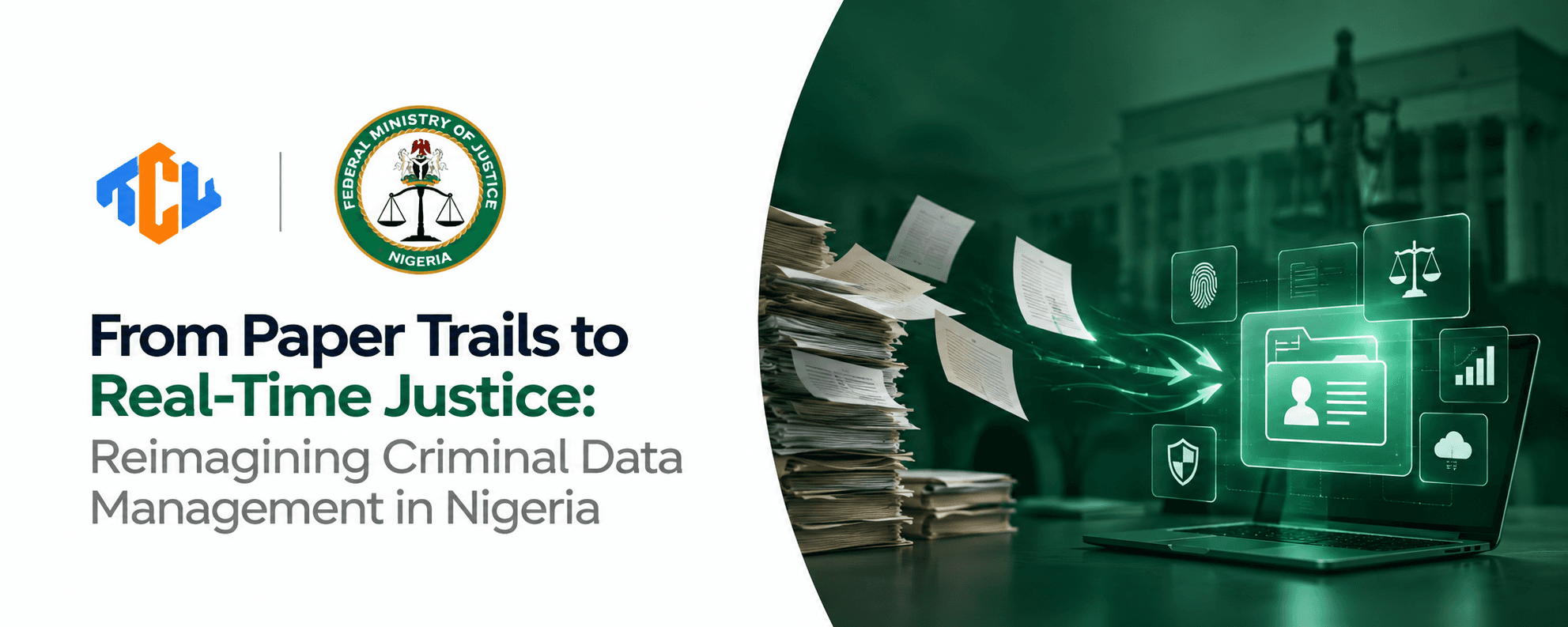
From Fragmented to Unified: Data once scattered across agencies is now centralized within a single, structured system.
From Delayed to Real-Time: Decision-makers can now access up-to-date information as events are recorded.
From Guesswork to Insight: Clear visibility into trends and patterns enables more informed, data-driven actions.
From Silos to Collaboration: Agencies now operate within a shared ecosystem, improving coordination and consistency.
From Delivery to Adoption: Most critically, the system is actively used and embedded into daily operations rather than sitting as unused infrastructure.
Project Details
Client
Federal Ministry of Justice (FMOJ)
Industry
Government & Legal
Duration
6 Months
Service
Digital Transformation & Process Automation
Category
Government & Public Sector“This system has fundamentally changed how we work. What used to take weeks now takes days. Our officers can focus on legal work instead of chasing paper.”
Director of ICT, FMOJ
Federal Ministry of Justice